
The Room as the First Teacher: What Children Learn From the Spaces Around Them
When we think about early years education, we usually think first about people.
The teacher.
The parent.
The other children.
The songs, stories, games and daily rhythm.
But there is another “teacher” in a young child’s life that we can easily overlook.
The room.
The space around a child is never just a background. It is quietly speaking all the time. It says: slow down or hurry up. It says: you are safe here or be careful. It says: make something, notice something, care for something, come together, go outside, try again.
In early childhood, children do not only learn from what we tell them. They learn from what they live inside.
This is one of the things I find so beautiful about Steiner/Waldorf early years education. The environment is understood as part of the child’s education, not simply the place where education happens. A young child learns through imitation, rhythm, movement, warmth, beauty, meaningful work and imaginative play. They absorb the world through their senses long before they analyse it with words.
So it is worth asking: what kind of world are we asking them to absorb?
One fascinating person connected to this way of thinking is the German architect Hans Scharoun. He was not a Steiner teacher, but his architecture shares something deeply sympathetic with the Steiner world: the belief that spaces should be shaped around human beings, not the other way around.
Scharoun was interested in schools that did not feel like factories or barracks. He did not want children marched through long corridors into identical boxes. He imagined school buildings that responded to the needs of children: places with smaller, more intimate areas, shared gathering spaces, movement, light and a sense of belonging.
I find this such a rich idea for early years.
What if a nursery, kindergarten or home is not simply a place where education happens?
What if the space itself is part of the education?
Adults walk into a room and often notice the obvious things: furniture, displays, paint colour, mess, whether everything looks tidy enough.
Young children experience space much more physically.
They feel whether a room invites them to rush or settle. They notice whether materials are cared for or thrown into plastic tubs. They sense whether the adults are calm or hurried. They respond to light, sound, texture, smell and rhythm.
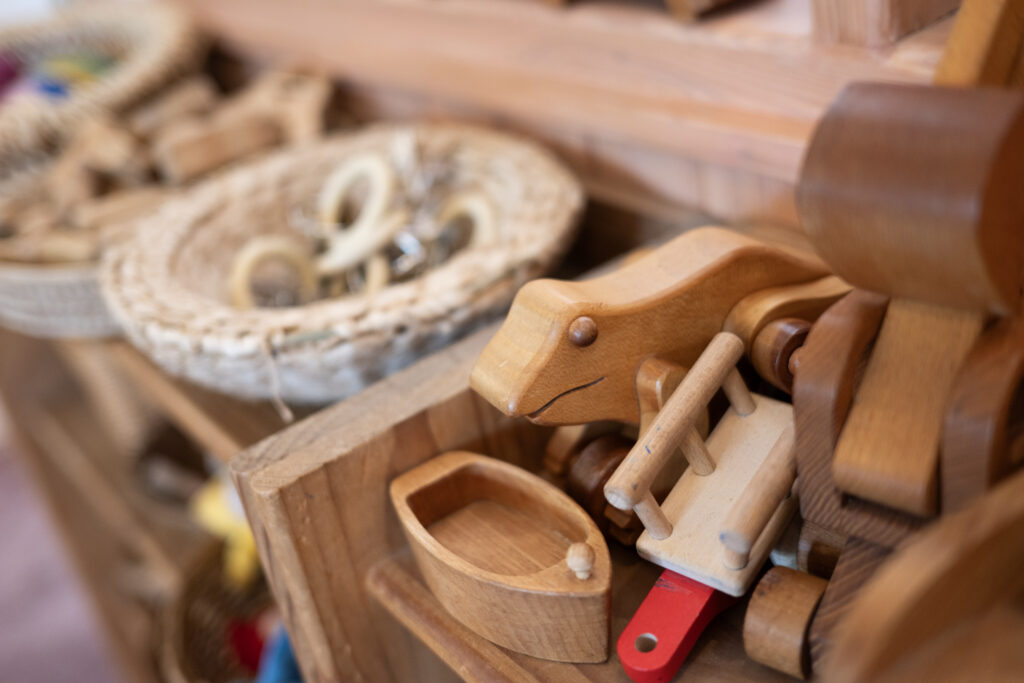
A wooden spoon, a basket of pinecones, a folded cloth, a candle at story time, a low hook for a coat, a familiar song at tidy-up time … these are not just decorative extras. They help form the child’s sense of the world.
They say: life has rhythm. Things can be beautiful. Hands can be useful. Nature is worth noticing. This is a place where I belong.
In early years settings, we often talk about the “curriculum” as if it is something written down in a folder. But for a young child, the real curriculum is also found in the daily atmosphere.
How do we greet each other?
How do we move from one activity to the next?
Is there time to become absorbed in play?
Do children see care being given to plants, toys, food, fabric and one another?
Is beauty present in simple, everyday ways?
This is where Steiner early childhood education can feel quietly radical.
It reminds us that children are not empty containers waiting to be filled with information. They are living, sensing, imitating beings. They are shaped by tone of voice, repeated gestures, seasonal rhythms, the way a table is laid, the way a story is told, and the way a room is prepared.
The environment becomes a kind of silent lesson.
Not a lesson in letters or numbers, but in how to be human.

One of the most helpful questions we can ask in early years is:
Is this environment worthy of imitation?
Not perfect. Not expensive. Not styled for social media.
Worthy.
Does it show care?
Does it invite imagination?
Does it offer warmth?
Does it make space for movement and rest?
Does it connect children to real materials and real work?
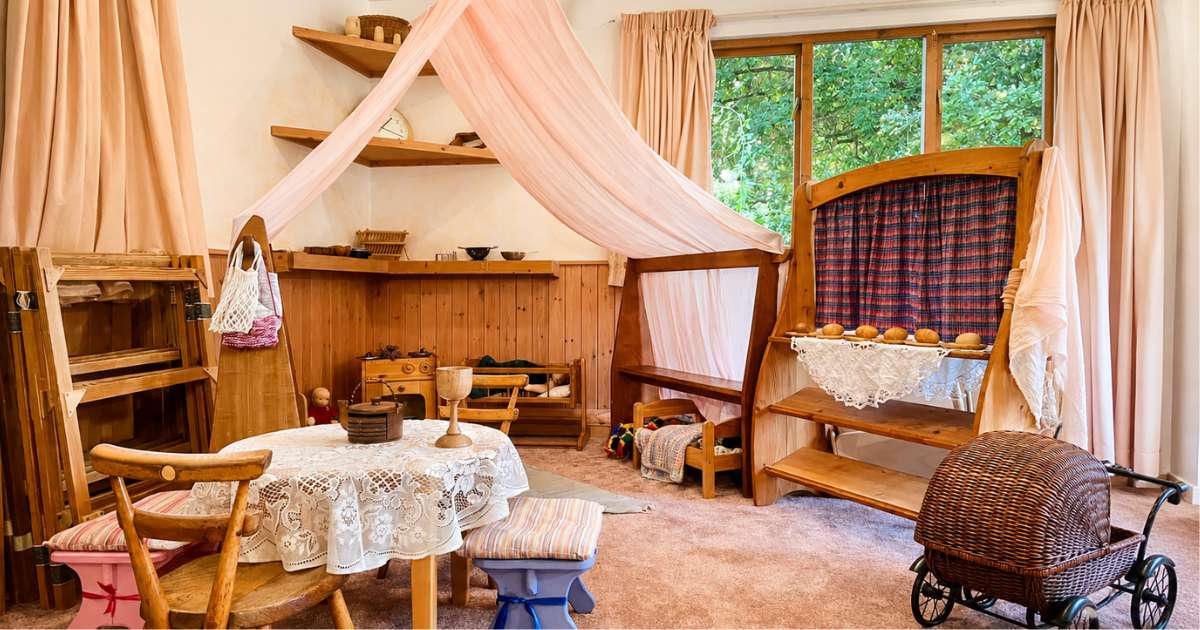
A beautiful early years space does not need to be elaborate. Often, the most nourishing spaces are simple: natural materials, open-ended toys, soft colours, places to retreat, room to move, access to nature, and objects that have a real purpose.
A child does not need a room full of flashing toys to imagine. They need time, space and materials that can become many things.
A cloth can be a river, a roof, a baby blanket, a cape.
A log can be a seat, a boat, a mountain, a shop counter.
A shell can be treasure.
A pinecone can become soup.
The less finished the object, the more room there is for the child.

This idea is not only for schools and kindergartens. It belongs at home too.
And the lovely thing is that it does not require a perfect house, a large garden, or a complete lifestyle overhaul. Most of us are working with ordinary homes, busy mornings, odd socks, crumbs, noise, toys under the sofa, and days that do not go quite to plan.
That is real family life.
So the question is not, How do I make my home perfect? The question is, What small changes would help this space feel calmer, warmer and more alive?
Start with one corner, one rhythm, or one daily gesture.
Choose a small area your child uses every day. It might be where they put on shoes, where they play, where they eat snack, or where you read together.
A low hook for a coat, a small basket for shoes, a cloth on a table, a few books in a basket, or a cosy cushion in a corner can make a space feel welcoming and purposeful.
Children love to feel capable. A home that says, you can help here, is quietly building confidence.

You do not need lots of toys to create rich play. In fact, fewer, simpler things often lead to deeper imagination.
Try offering open-ended materials: cloths, blocks, shells, pinecones, baskets, ribbons, spoons, bowls, stones, simple dolls or animals. These can become almost anything in a child’s play.
You might rotate toys rather than having everything out at once. A small, cared-for selection often feels more inviting than a crowded shelf.
Young children love real life. They want to stir, sweep, carry, wash, fold, dig, pour and sort.
Instead of always trying to occupy children while we “get things done,” we can sometimes let them join us in simple ways.
They might rinse apples, tear lettuce, match socks, wipe a table, water plants, brush crumbs, knead dough or carry napkins.
The task may take longer. It may not be done perfectly. But the child is learning something precious: I am part of this home. My hands are useful. Work can be shared.
Rhythm is one of the simplest ways to help home life feel more secure.
This does not mean a strict timetable. It means creating familiar anchors in the day.
A morning song while opening the curtains.
Lighting a candle before supper.
A basket walk after lunch.
Bath, story, song and bed in the same order.
Pancakes on Saturdays.
Soup on rainy days.
Children do not need every day to be identical, but they are deeply comforted by patterns they can recognise.
Nature does not need to be grand. A small pot of herbs, a jar of seasonal flowers, a bowl of conkers, a feather found on a walk, or watching the moon from the window can all help a child feel connected to the living world.
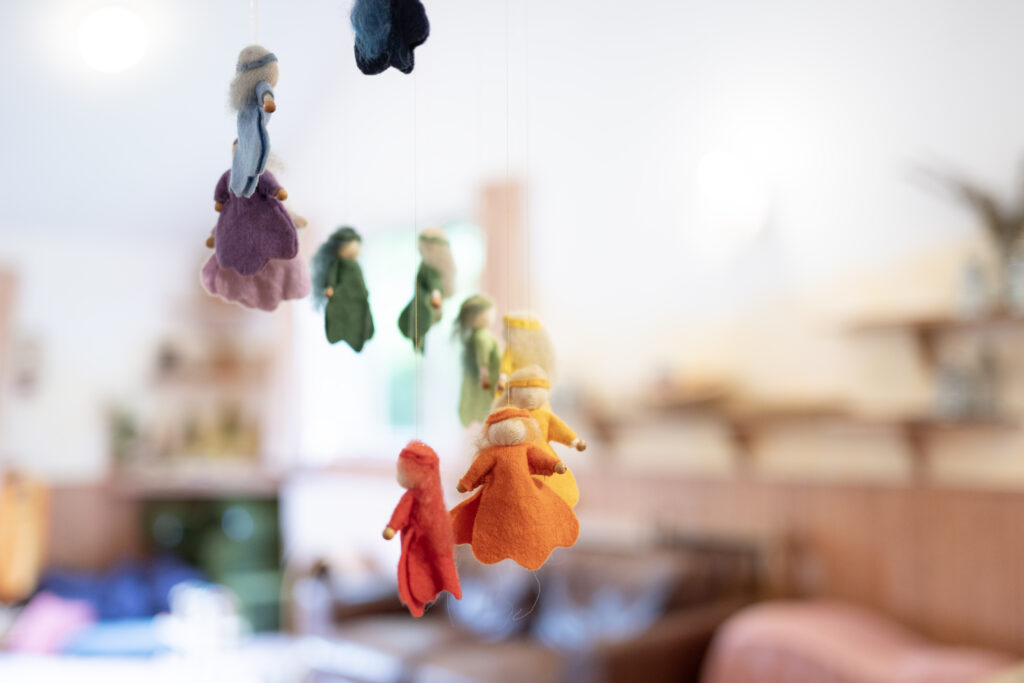
You might create a tiny seasonal table with one or two simple objects: a leaf, a stone, a candle, a postcard, a little handmade figure, a flower in a jar.
The aim is not decoration for decoration’s sake. It is a quiet reminder that the year is turning, the world is changing, and there is always something worth noticing.
Hans Scharoun’s architecture gives us a lovely provocation: perhaps we should design spaces not only for efficiency, but for becoming.
And Steiner early childhood education asks something similar: what kind of human qualities are being nourished here?
Wonder?
Care?
Patience?
Imagination?
Belonging?
Joy?
The young child is not only preparing for school, or for reading, or for the future. The young child is meeting the world for the first time.
So the spaces we offer them matter.
The room is not everything, of course. Love matters more. Relationships matter more. But the room is never nothing.
It can help hold the rhythm.
It can invite care.
It can make space for imagination.
It can remind a child, in quiet ways, that they belong.
And perhaps the best early years spaces are the ones that quietly say, every day:
You are safe.
You are capable.
The world is beautiful.
There is time.
There is rhythm.
There is work worth doing.
There is room to imagine.
You belong here.
