

At first glance, a Steiner Waldorf kindergarten can look surprisingly simple.
There may be a teacher kneading bread dough at a wooden table, humming quietly as their hands press, fold, and turn. Another adult might be sweeping the floor, preparing fruit for snack, mending a doll’s dress, polishing shells for the nature table, or folding cloths with slow, careful movements. Around them, children move in and out of play. Some join the activity for a moment. Some watch from the corner of the room. Some seem completely absorbed in their own world.
To a visitor, especially one used to a more conventional nursery or reception classroom, it may look as though not much “teaching” is happening.
There are no worksheets on the table. No phonics sounds being drilled. No adult sitting with a clipboard asking children to identify numbers, shapes, or colours. The teacher is not constantly explaining, questioning, praising, correcting, or directing.
And so a very understandable question can arise for parents:
Are the children actually learning, or are they just copying what the adults do?
This is one of the most misunderstood aspects of Steiner Waldorf kindergarten education: the role of imitation.
In everyday language, imitation often sounds like something small. We might think of it as copying without understanding, repeating someone else’s actions, or doing something because we have not yet developed our own ideas. From this point of view, imitation can seem passive, even uncreative.
But in the Waldorf kindergarten, imitation is understood in a much deeper way. It is seen as one of the young child’s most natural, powerful, and intelligent ways of learning.
Young children do not learn only through being told. In fact, in the early years, too much explanation can easily float over their heads. The young child does not usually become kinder because an adult gives a long explanation about kindness. They do not become careful because someone lectures them about responsibility. They do not develop patience because they are told, again and again, to be patient.
They learn these things by living among people who embody them.
They learn through tone of voice. Through gesture. Through atmosphere. Through rhythm. Through repeated daily actions. Through the way adults move, speak, care, repair, prepare, comfort, and begin again.
In other words, they learn through imitation.
A young child is constantly taking in the world. Not just with their mind, but with their whole body. They notice how an adult pours water into a cup. They notice whether the adult rushes or takes care. They notice how a teacher welcomes a late child into the room. They notice how someone responds when the bread dough falls on the floor, when a tower is knocked down, when a friend cries, when the room becomes noisy, when a task becomes difficult.
Children may not be able to explain what they have observed, but they absorb it.
The kindergarten child is always asking, silently:
How do people live?
How do we care for one another?
What is worth doing?
How do we meet the world?
And the adult answers, not mainly through instruction, but through example.
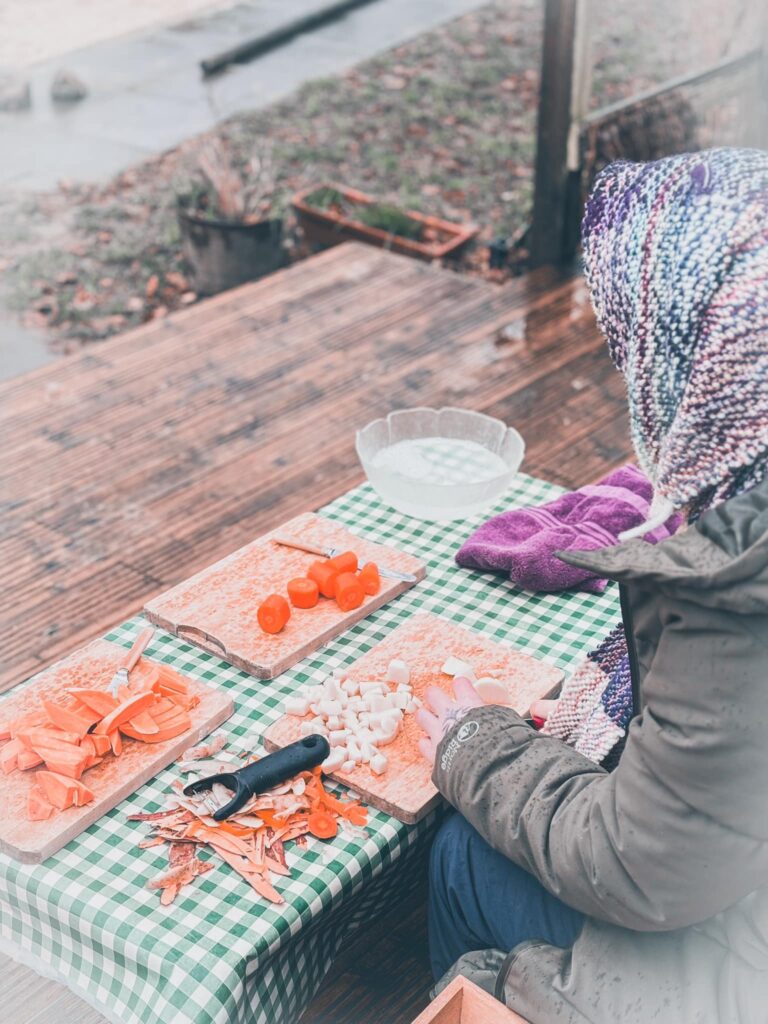
This is why the work of the Waldorf kindergarten teacher can look so ordinary from the outside. Baking bread, chopping vegetables, sweeping the floor, washing cloths, gardening, sewing, tidying toys, arranging flowers, lighting a candle, singing a familiar song. These are not simply domestic jobs used to pass the time. They are purposeful, visible, meaningful activities that belong to real life.
They give the child something healthy to imitate.
When a teacher kneads bread, the child sees effort, rhythm, transformation, and care. Flour becomes dough. Dough becomes bread. The bread is shared. The work has meaning. It feeds the group.
When a teacher mends a torn cloth or doll, the child sees that broken things are not immediately thrown away. They can be tended to. They can be repaired. Care can restore something.
When a teacher sweeps the floor, the child sees that the room matters. The space we share deserves attention. Our surroundings are not someone else’s responsibility.
When a teacher gently comforts a crying child, the others see tenderness in action. They learn what comfort looks like, not as an abstract idea, but as a living gesture.
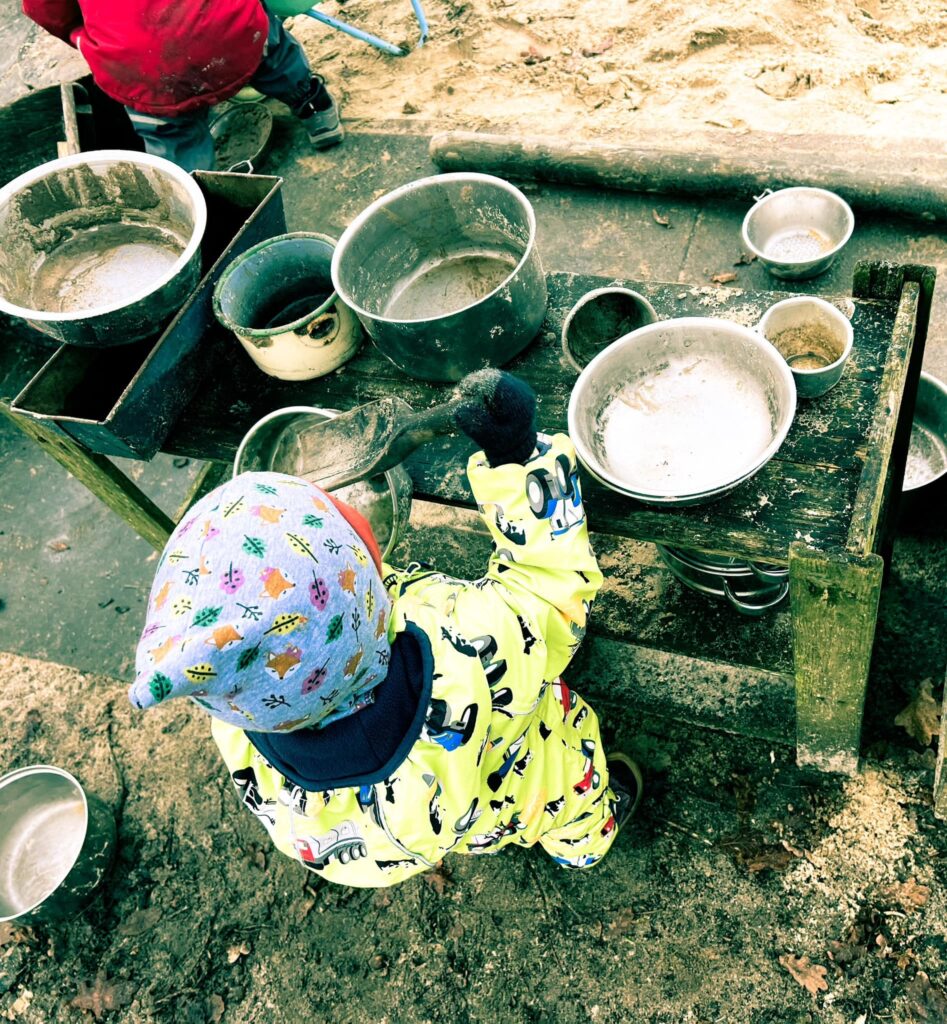
None of this needs to be turned into a lesson with a title and objective. In fact, the power of it often lies in the fact that it is not over-explained. It belongs to the flow of life.
This is where the misunderstanding can happen. Many parents have been taught to recognise learning only when it produces something visible: a written name, a counted set of objects, a painted picture to take home, a worksheet, a reading level, a tick on an assessment sheet. Waldorf kindergarten asks us to notice another kind of learning: the quiet forming of habits, capacities, and inner pictures.
A child may appear not to be paying attention to the teacher sewing a simple seam. They may be building a den across the room or rocking a doll to sleep. But later that day, or even days later, the same child may wrap a cloth around a stick and say they are “fixing it.” They may tuck a blanket around a younger child with exactly the same gentleness they have seen from the teacher. They may hum the bread song while patting mud in the garden.
This is imitation, but it is not mechanical copying.
It is creative digestion.
The child takes something from the adult world, carries it inward, and brings it back out through play. Often it changes form. Sweeping becomes a game of “making the house ready.” Baking becomes mud pies in the garden. Mending becomes wrapping, tying, healing, rescuing. A teacher’s gentle phrase becomes part of a child’s own attempt to resolve conflict.
The child is not a photocopier. The child is an artist of experience.
In Steiner Waldorf education, the kindergarten years are viewed as a time when children learn most deeply through movement, senses, rhythm, relationship, play, and imitation. The young child is not treated as a small adult who needs everything explained intellectually. They are seen as a being who learns first through doing, feeling, observing, and participating.
This does not mean the child is empty or unthinking. Quite the opposite. Anyone who has spent time with young children knows how intensely awake they are. They notice tiny details adults overlook. They repeat phrases we did not realise we had said. They copy gestures we did not know we made. They sense moods we thought we had hidden.
This is why the adult’s role in a Waldorf kindergarten is so important.
The teacher is not simply supervising from the edge of the room. Nor are they constantly directing every child’s play. Instead, the teacher is creating an environment, a rhythm, and a way of being that is worthy of imitation.
That is a subtle and demanding form of teaching.
It asks the adult to think about how they enter the room in the morning. How they speak when things go wrong. How they move from one activity to another. How they hold boundaries without harshness. How they invite children into work without pressure. How they care for objects, for nature, for food, for the group.
For example, rather than saying, “Everyone must tidy up now,” a Waldorf teacher may begin quietly folding cloths or singing the tidy-up song. The gesture itself invites the children. The song carries the transition. The children join because the activity has rhythm and meaning, not simply because they have been ordered to comply.
Of course, boundaries still exist. Waldorf kindergarten is not a free-for-all. But the boundaries are often carried through rhythm, imitation, and atmosphere as much as through verbal instruction. The adult tries to lead in a way that the child can enter naturally.
This can be difficult for parents to understand at first, especially if we associate good teaching with constant verbal engagement. We may expect the teacher to explain everything: why we tidy up, why we share, why we wait, why we wash our hands, why we are gentle with the toys. Explanations have their place, but in the kindergarten years, Waldorf education tries not to make the child live too much in the head too soon.
Instead of saying, “We must respect our environment because shared spaces are important,” the teacher simply cares for the room every day.
Instead of giving a speech about gratitude, the children help prepare snack, sit together, sing a blessing or verse, and share food.
Instead of discussing sustainability in abstract terms, they compost peelings, water plants, mend cloths, collect leaves, and notice the seasons.
The ideas are there, but they are clothed in action.
This is one of the beautiful things about imitation in the kindergarten: it protects childhood from becoming overly intellectual too early, while still offering rich moral, social, and practical learning. The child does not have to step outside life in order to learn about life. They learn by being immersed in it.
There is also a social dimension to imitation. Children imitate not only adults, but one another. A child who sees others helping to set the table may join in. A younger child may watch an older child tie an apron, carry a basket, or build a bridge with planks. Mixed-age kindergarten groups often rely on this gentle flow of imitation. The younger children are lifted by the example of the older ones, and the older children grow in confidence by becoming examples themselves.
This is not the same as forcing children into adult expectations. In a healthy Waldorf kindergarten, imitation is not used to produce perfect little helpers or obedient performers. The aim is not to make every child behave the same way. The aim is to surround children with actions that are meaningful enough, beautiful enough, and human enough that they naturally want to take part.
That distinction matters.
Imitation should not feel like pressure. It should feel like invitation.
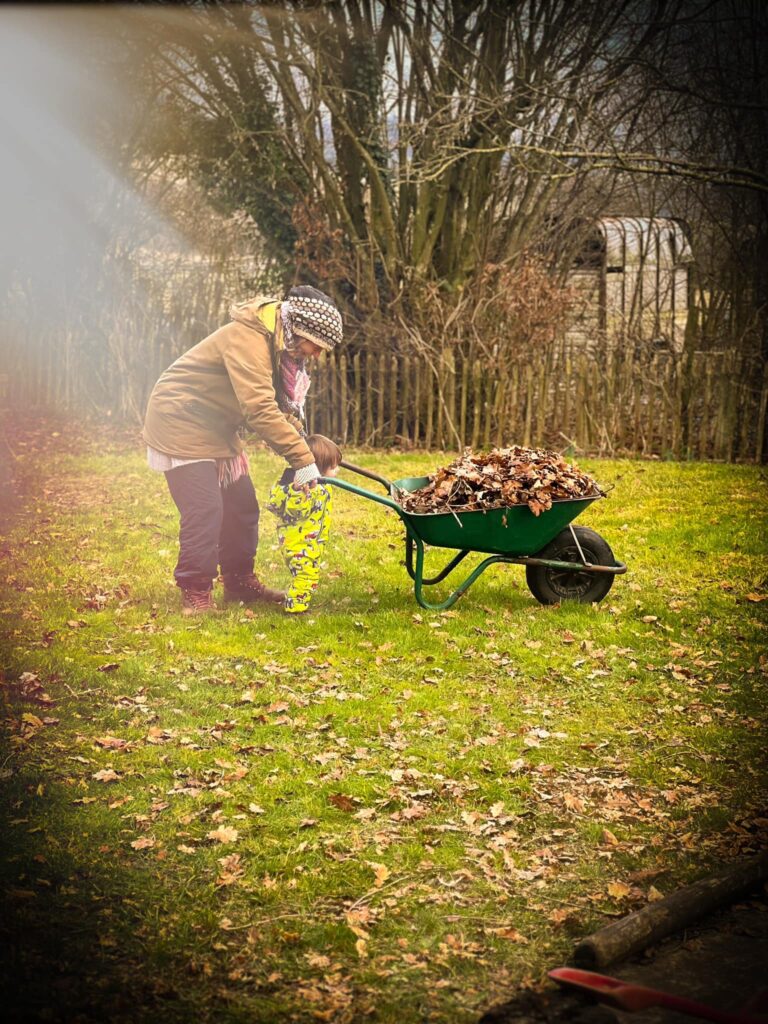
The child sees bread being made and wants to press their hands into the dough. They see leaves being swept and want a small broom. They hear a song and begin to hum. They see a doll being cared for and begin to rock it. They see a teacher pause before speaking and, slowly, over time, they begin to find that pause within themselves.
This is learning that happens from the inside out.
For parents, this can be both reassuring and confronting. Reassuring, because it reminds us that children are learning all the time, even when it does not look like school. Confronting, because it also reminds us that children imitate us at home.
They imitate how we speak when we are tired. How we handle frustration. How we treat the objects in our home. How we greet people. How we use our phones. How we apologise, or do not. How we move through ordinary tasks.
This does not mean parents need to become perfect. Children do not need perfect adults. They need real adults who are trying. Adults who can repair after losing patience. Adults who can show care in ordinary ways. Adults who can slow down sometimes. Adults who can say, “I’ll try that again.”
In fact, repair may be one of the most important things children can imitate. When an adult makes a mistake and then makes amends, the child learns that mistakes are not the end of the story. Relationships can be mended. Words can be softened. A difficult moment can be transformed.
That, too, is education.
So when we look into a Waldorf kindergarten and see children “copying,” perhaps we need to look again.
The child stirring an imaginary pot is not merely copying cooking. They are practising care, sequence, nourishment, and belonging.
The child wrapping a doll in a cloth is not merely copying the teacher. They are practising tenderness.
The child sweeping leaves into a pile is not merely copying a chore. They are experiencing contribution.
The child singing the same song while tidying is not merely repeating. They are entering rhythm, memory, and shared purpose.
The child who speaks gently to a friend after hearing gentleness from an adult is not just echoing words. They are beginning to carry a social gesture into their own life.
In this sense, imitation is not the opposite of creativity. It is one of creativity’s foundations. Before children can invent freely, they need rich experiences to draw from. Before they can act independently, they need meaningful actions to internalise. Before they can make wise choices, they need to have lived among adults who model care, purpose, patience, and joy.
The Waldorf kindergarten offers the child a world of gestures worth taking in.
That is why the teacher’s work is often quiet rather than showy. It does not always announce itself as teaching. It may look like folding, sweeping, singing, stirring, waiting, listening, and beginning again.
But beneath those simple gestures, something profound is happening.
The child is learning how to be human.
So perhaps the question is not, “Are they just copying?”
A better question might be:
What are we giving them that is worthy of imitation?
