

There’s something quietly magical about stepping into a kindergarten where storytelling and imagination are truly valued. It’s not loud or overstimulating. Instead, it feels calm, rhythmic, and intentional, almost like entering a slower, more thoughtful version of the world.
At Chartham Holistic Kindergarten, we draw inspiration from approaches within Waldorf early education, originally developed by Rudolf Steiner, particularly in the way we work with storytelling and puppetry in the early years. What’s interesting is that many of these practices also align closely with what modern research tells us about how young children learn and develop.
In our kindergarten, stories are often told rather than read. The teacher gathers the children and begins without pictures or books using voice, gesture, and presence to bring the story to life.
From a developmental perspective, this matters more than it might first appear. When children listen to stories without fixed images, they actively create their own mental pictures. Research shows that storytelling supports imagination, memory, and language processing, as children learn to visualise and make sense of spoken words internally.
Without a fixed image, each child builds their own understanding of the story and that act of “inner picture-making” is a key part of cognitive development.
We also value repetition. The same story may be shared over several days, allowing children to become familiar with it, anticipate key moments, and absorb the language in a natural and unhurried way. Studies suggest that storytelling strengthens working memory, sequencing skills, and attention, all of which are foundational for later learning.
Storytelling is now widely understood as a powerful tool in early childhood development.
Through stories, children:
In other words, storytelling doesn’t just support literacy…it supports the whole child.
Alongside storytelling, we share simple puppet shows.
These are calm, slow, and focused on atmosphere rather than performance. A small scene might be created using cloths, natural materials like stones or shells, and a few figures, with gentle movement and quiet pauses.
In a Steiner-inspired approach, puppetry is not so much about acting out a story as it is about revealing it quietly. The gestures are minimal, the pace is unhurried, and there is space for stillness. In this way, the child is not overwhelmed by action, but invited inward to meet the story through feeling and imagination.
The puppet show becomes a kind of bridge between the spoken word and the child’s inner world. What has been heard in the story is now seen in a living, breathing form, yet still held in a gentle, dream-like quality.
Over time, these experiences live on in the child’s play. The images are taken up, transformed, and reimagined in their own way.
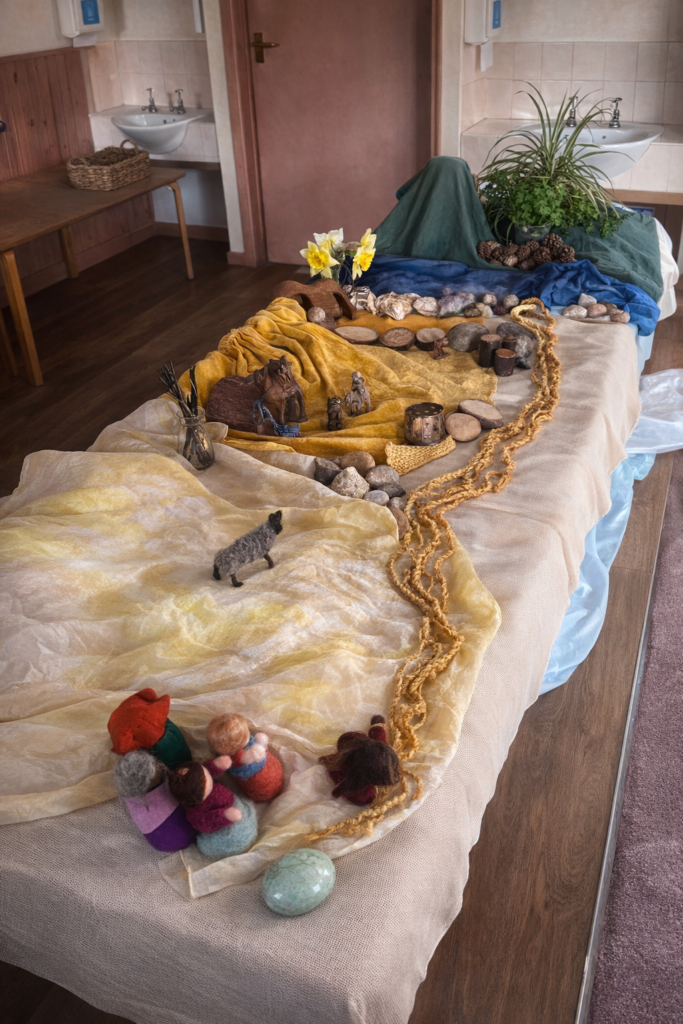
The puppets we use are simple and made from natural materials such as wool, cotton, or felt.
The simplicity is quite intentional. In the early years, it is not the fully formed image that nourishes the child most deeply, but the suggestion of form. A softly shaped figure, with only the lightest indication of features, allows the child’s imagination to remain active and alive.
A very simple puppet—a cloth, a soft figure, even a knotted piece of fabric can become many different characters. It is not fixed. It can transform, just as the child’s inner images are fluid and changing.
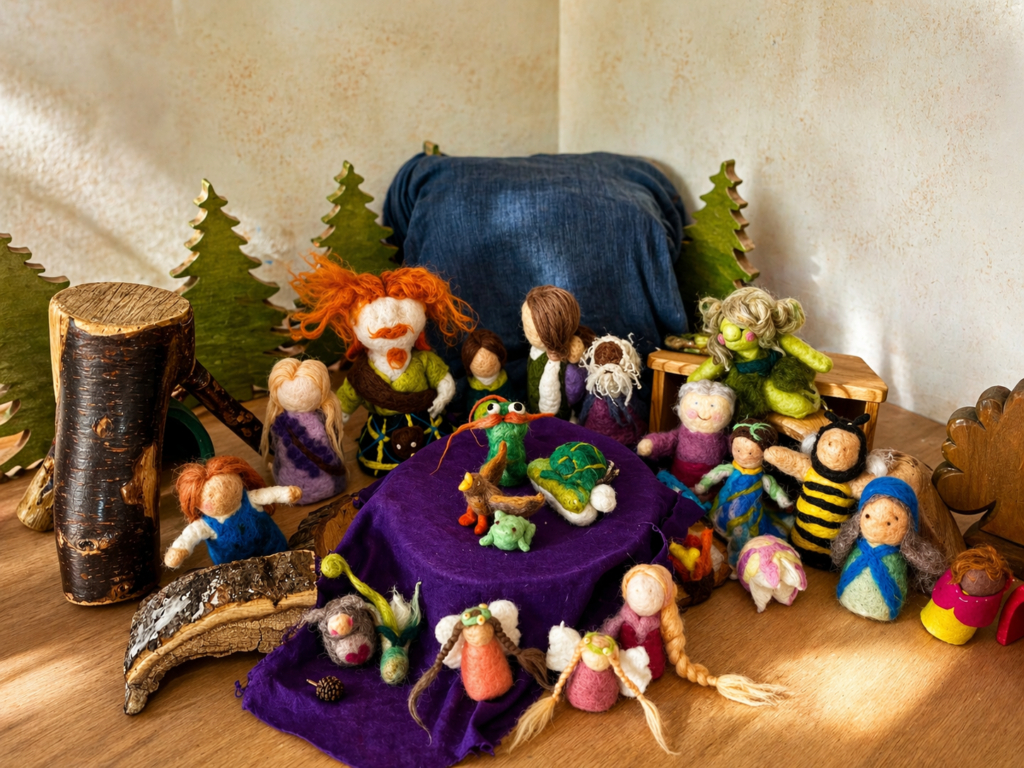
More detailed puppets also have their place, particularly when bringing a specific story or seasonal figure to life. Yet even these are usually gentle and understated, leaving space for the child to meet them imaginatively rather than passively. The image below is of handmade puppets made by our wonderful CHK staff using the simple process of needle felting.
You may notice a seasonal display in the room, often called a nature table. This changes throughout the year, reflecting the seasons with different colours, textures, and natural objects.
In a Steiner-inspired setting, the changing seasons are an important part of the child’s experience. The nature table offers a quiet way to honour this rhythm. Small figures, cloths, and natural elements come together to create simple scenes that echo what is happening outside.
Sometimes, the figures from the nature table appear in a story or puppet show. When this happens, there is a gentle sense of recognition for the child—something familiar that has now come to life. In this way, the environment, the story, and the child’s experience are all connected.

At its heart, this approach is about creating a calm and nurturing environment where children can explore language, imagination, and storytelling at their own pace.
At Chartham Holistic kindergarten, there is a deep trust in the child’s inner life, their ability to receive, to imagine, and to make meaning in their own time. By keeping things simple, rhythmic, and sensory, we aim to protect and nourish this capacity.
There is no need to hurry the experience. A story told slowly, a puppet moving gently across a cloth, a familiar figure resting on the nature table.. these small moments carry a quiet depth.
It is a gentle approach, but a deeply meaningful one, and one that continues to shape the atmosphere of our kindergarten each day.

Ewout says:
Such a beautiful description of this essential Early Years practice. It actually moved me.